SIDigital Animation


Industry Events
A recollection of the various different industry events I attended between May 2023 to April 2024.
Coffee & TV - Studio Visit [25/05/23]

When we visited the Coffee & TV studio, I met a fair amount of animators and got some feedback on my Spring 2023 showreel. They thought it was interesting, but did have some words of advice on improving my skills. They spoke about how adding lighting and rendering to a sequence would make it more engaging with the audience, as it adds more to visual flavour and adds to the appeal.
They spoke about how interesting it is to cut on action, which allows for more energetic storytelling and feels the impact of the action while naturally transitioning between two shots. Specifically one example they gave was in reference to a punch. “If Person A punches Person B, they punch them in two shots. In the first shot, A gears up to punch B which provides anticipation for the leading action. Cut to Person B getting punched with overshoot and settle.”
During this time, I was considering the Generalist role for commercials and roles in non-film and TV sectors so it was interesting to hear about what would be necessary for a Generalist portfolio. Even if I wasn't ultimately exploring this for Portfolio, it was good information to know.
-
Focus on modelling and rigging. No need to be great at animation.
-
No need to be ambitious with the scale of your project, but rather be more effective at the quality of the project. No matter how ‘simple’ or ‘grand’ it may be.
-
A good design sense is required. A Generalist needs to make something look good and move good.
-
It is much better to have a great 5 seconds in your project than an average 30 seconds. Quality over quantity.
In addition, I had the opportunity to go through a mock interview for their open runner position. There were a lot of interesting questions which gave me a good opportunity to understand what was expected of the role and let go of the nervous expectations I had for interviews.
Festivus [08/06/23]
Festivus is a recurring animation social event hosted by Rob Doherty at Betjamin Arms in King's Cross.
At the event, I managed to meet several animation artists across England, including ones from DNEG. (For full list, see LinkedIn image on the right.) I got some advice in order to research my animation level in regards to the companies I was interested in. I was informed to look at people who got in entry level jobs for the roles I want, and set that as the base minimum of where I need to reach,
One animator I met was Alice Seatherton, a 2D Freelancer Animator who did work on Helluva Boss and various V-Tuber avatars. While hearing her experience was fun, I was really fascinated by her lockscreen business card. I liked this idea so much, I created my own version to promote myself (see “Self Promotion”)
The environment was quite noisy, so it was difficult to have quality one on one conversation, but it was really nice to engage with other artists. I got some advice from the DNEG artists in order to research my animation level. I was informed to look at people who got in entry level jobs for the roles I want, and set that as the base minimum of where I need to reach.
It was such a fun event and engaging with artists and communities within the animation industry was such a delight!


How to Script Coordinate - The (Kinda) First Step to Being a Writer (Allegedly)
by Shelby Peake [15/09/2023]
Shelby Peake is a Script Coordinator who has script and continuity credits for a variety of Netflix films, including but not limited to: Over the Moon (2020), The Sea Beast (2022), and Ultraman: Rising (2024). She gave a talk about her experience Script Coordinating for the films in the Queer Trans in Animation Discord group I am a part of. (See Self-Promotion's Social Media tab)
-
The pipeline in films are more so surrounding script segments to animation rather than a full episode script like TV. So screenwriters would create certain sequences and each of those chunks will be developed asynchronously across the time of the film.
-
Keeping track of the progress of each line, voice reading, directors notes, and script shot and its progress highlighted how important organisation is
-
Informed me of other roles within screenwriting which may appeal to me.
A Script Coordinator doesn’t have a direct say in the script, and is not considered a writer of any sort. A script coordinator helps with administrative work such as:
-
Conforming scripts after each draft
-
Sending watermarked scripts to executives for review
-
Schedule meetings and notetaking during writing sessions
-
Maintaining an organised and detailed tracking system for script iterations during production, including recording sessions, tracking dialogue, generating reports, and scratch recordings.
This role requires an exceedingly necessary level of clear communication between executives, writers, producers, voice talent, and animators. Noting how many lines each character/actor has, who their scratch actor is, the total number of lines they have to record, etc. Although a preproduction role, it is very important as a role to track the information for the film.


ACCESS:VFX - End the Summer with XVFX [21/09/23]


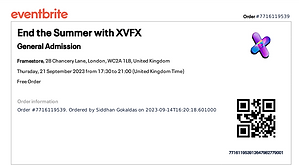

This was a celebration social event for VFX artists hosted by Simon Devereux, organised by ACCESS:VFX at Framestore London. At the event, I met Marcus Ayerton, a former alumni and currently working at The Third Floor as a 3D Previs Artist. Spoke about VFX artists and the strikes currently going on for SAG-AFTRA and WGA in America.
In addition, there was a panel with various number of VFX artists of colour speaking on their experiences as artists of colour in the VFX industry. Some of the artists include:
-
Alisha Huxtable, Line Producer at DNEG
-
Derin Owodunni, Labs Support Engineer at Framestore
-
Hameed Adigun, Creative Storyteller
Some of them spoke how they initially did not intend to be VFX artists, and instead got into the industry through being inspired by anime or careers fairs during their time in education; whereas some others were naturally intrigued with media analysis based on creative engagement when young. “The path you enter the industry through isn’t the path you’ll stay on. Your career can take you anywhere, it’s up to you if you decide to follow it or not.”
They spoke on their challenges as BIPOC (Black, Indigenous, People of Colour) VFX artists being within the industry which resonated with me quite a bit in regard to being the only BIPOC or international person in a room of national residents. The topics ranged from:
-
being people wanting to pursue art from a familial/societal background which is more focused on academics and “successful” subjects like doctors, lawyers, etc;
-
the importance of speaking with other Black or POC artists to understand experiences at different companies or with different artists to find trust or a community within the industry; and,
-
the importance of passion as a driving force. By having passion in your area, you will keep pushing through the hard parts because you are working on something or somewhere that is near and dear to your heart.
This was a really lovely event, and I felt so seen and heard hearing a community of other POC artists and their experiences.
The LINE: 10 Year Anniversary [21/09/23]
This event happened at the same day and time as End the Summer with XVFX. My peers and I were at the same events and we travelled as a group. This event was more of a party: far louder and far more chaotic which was beyond my expectations in comparison to End the Summer with XVFX. Although I didn’t stay long since the loud music and conversation was giving me a sensory overload, this was an important experience in understanding the different types of animation events that would happen.


RAVELate [05/10/23]
RAVELate is an after-hours careers event at Ravensbourne University, London specific to their students. I had the opportunity to join the first RAVELate of 2023, featuring Ace Ruelle and Stephanie Boateng. While this was more of a panel talk, I've put down the notes I took of the event and my reflection on it.


Ace Ruelle (Creature Mechanics Actor & Founding Director of Creature Bionics)
-
Creature Mechanics actor at Creature Bionics, specialising in motion capture for fantasy characters and creatures for film, tv and videogames.
-
Spoke about the four character-narrative objectives discovered during the process, in a way outlining the character's story:
-
Character’s Purpose: Why do they exist?
-
Character’s Mission: What is their journey of completing their purpose?
-
Character’s Psychology: What is the character’s overall personality and behaviour? How do they interact?
-
Character’s Physicality: How do they move and socialise in relation to their psychology?
-
-
Spoke about the character’s previs objectives for their physical and technical movement. While this is more tailored to games specifically, it is interesting to engage with as previs tests before moving to keyframes.
-
Idle: What is their neutral posture?
-
Locomotion: What is the character’s generic movement? How do they walk? How do they run? Etc.
-
Movement coordination: How does the character move in certain scenes?
-
Action Design: How the character interacts in combat or physical engagement?
-
-
Spoke about the casting, performances, and the utilisation of the machinery used for the creature motion capture. The usage of the mechanical equipment make the motion capture fit the rig used.
Stephanie Boateng (Ghanaian-British Director and Writer)
-
Ghanaian director and writer and spoke of experiences which felt similar (not the exact same) and familiar to me.
-
Stephanie spoke about how she initially went into storytelling thinking she wanted to tell big action sequences or really intense scene, but instead was guided to "tell her truth" with smaller and more personal stories which have guided her. I think this is something I like to do when approaching my stories is finding the emotional connection and an underrepresented aspect within that story.
-
The voice you have is individually yours. It is what will make you stand out in your storytelling and your identity as an artist.
Directorial Debut of Andreas Deja "Mushka" [23/10/23]


I was had the privilge to view the the directorial debut film "Mushka" by Disney animator Andreas Deja. The story focuses on the relationship between a young girl and a young tiger. (Watch the film's trailer here)
I liked the film a lot, but wasn’t appealed by the style which was very 2D Disney-esque. I personally did not grow up on the Disney Renaissance films so I did not have nostalgia or connected with the style too much. However I did like how the animation had pencil marks, making it feel very human and having a stylised effect rather than being a super polished piece akin to The Lion King (1994) or Hercules (1997).
After viewing the film, he gave a talk on the development of his film where he studied tigers at zoos: how they moved, poses they would make, etc. This was really incredible to see how important research was to understand character movement. Despite the film being 2D, it was interesting how they experimented with clay models for previs and explorations for research as well. Deja spoke about how he had certain visual elements of the story, then worked together with a screenwriter who brought in the element of the main character being an adult at the beginning and end in order to have a circular conclusive narrative.
After the event, the viewing party moved to a nearby pub and I met a few people of note there.
-
Shannon Tiddle, Director of limited series Lost Ollie and Netflix’s upcoming Ultraman: Rising film. He spoke a bit about his excitement for the Ultraman film coming up.
-
Met Jake Lee, an acquaintance from my Escape Studios workshop, and we reconnected over Escape Studios and our careers as 3D animators.
MCM London Comic Con [27/10/23]


For MCM London Comic Con, I met two industry professionals: Hamish Steele and Joe Sparrow.
Hamish Steele is the creator and showrunner of Dead End: Paranormal Park for Netflix. BLINKINK, a 2D animation company, did the animation in ToonBoom Harmony. The characters had their close up design, and a more simplified look when they were further away. It was really amazing meeting him. Joe Sparrow is an illustrator and was previously a storyboard artist on Disney Channel’s Amphibia. We had a conversation about his experience on Amphibia and how his ability to work remotely on the show was due to the COVID-19 Pandemic.
It was really amazing engaging with audiences of different varieties, tastes and interest. Many attendees were cosplaying as different characters, so some unique designs were inspiring.
Animation & VFX Union - November Social [01/11/23]

In November, I went to a social event hosted by the Animation & VFX Union team in London. We initially had difficulties finding the location since it was hard to find people there, but we got there!
At the event, we spoke to VFX artists about the SAG-AFTRA/WGA strikes and how it was affecting post-production and VFX artists, considering company-wide layoffs occuring. Specifically met Suraj Harrington-Odedra, a VFX Supervisor at Territory Studios in London, and Niki Kehoe, a senior Harmony Rigger at Blink Industries, who gave me feedback on my work (see "Industry Feedback")
Ollie Trotman, Senior Games & VFX Animator [10/11/23]


Ollie Trotman is a Senior Games and VFX animator, currently at Sumo Digital, and came to give us a talk on his journey as a 3D animator throughout the years. During my experience as a second year animation student, he was also my mentor on my Moon Girl character performance audio animation.
During his animation studies, portfolio developmental free use rigs were non-existent, so he and his classmates had to model, rig and animate their own rigs which was an incredibly intimidating concept to me. He started to work in Maya when it was very young. So his journey was really inspiring to see that the animation has to be good, but it doesn’t need to be feature level - especially for a student.
I really enjoyed a lot of his games animation, specifically one animation of a clicker mouse as an enemy the player would have to fight against. He showed us things he tried to do to make his showreel more engaging, like transitioning between animations using the same background but he noted his realisation that it would distract the recruiter or viewer rather than focus on his animations specifically.
Industry Talk - Vanessa Alessi, Senior Animator [17/11/23]
Vanessa Alessi is a Senior Animator, currently at Red Parrot Germany and previously at DNEG’s Toronto and London branches. She is an international artist from Toronto, Canada who immigrated to London so it was interesting to hear her journey since I also immigrated to the UK.
She gave a lot of amazing advice, including on how to get an interview (industry events, LinkedIn, Studio Websites, and Networking) and how to prepare for one. She spoke about we as students (soon industry artists) should be knowing our worth by determining your skill level based on a variety of factors: our speed, quality of work, ability to take on complex work, solid workflow, & learning how to ask for and be able to take criticisms. She provided a helpful link from a group called SaltyAnimators who have compiled willing animation artists rates, locations, companies, etc. to be aware of the general rates; and also encouraged us to ask what benefits the studio offers in terms of benefits, and how we as artists have the ability to negotiate for better benefits, as well as understanding our rights.

Industrial Light and Magic - Studio Visit [17/11/23]
I was a part of a group of students with the opportunity to visit to Industrial Light & Magic London, hosted by Margit Norom with 3D mid-animators Daisy Summerfield and Holly Whithouse
-
They have a VFX apprenticeship: Jedi Scheme. It would be interesting to apply.
-
Talked about Lost Ollie, a project both Daisy and Holly worked on.
- Provided advice as artists and animators
-
Gave a reminder which I did not realise I needed: “You don’t need to be the best.” But instead:
-
You need to be someone nice to work with
-
You need to have a willingness to learn
-
You need to know how to take criticism
-
-
-
Daisy and Holly recommended learning animbot to help with animation workflow
-
What does Industrial Light and Magic looks for in a showreel?
-
Looking for Body Mechanics and Creature work.
-
Don’t be too ambitious
-
If there’s something that you’re not sure or conflicted about, remove it. Better safe than sorry.
-


Getting into Visual Effects - Access VFX Conference at Framestore [22/11/23]

When we visited the Coffee & TV studio, I met a fair amount of animators and got some feedback on my Spring 2023 showreel. They thought it was interesting, but did have some words of advice on improving my skills. They spoke about how adding lighting and rendering to a sequence would make it more engaging with the audience, as it adds more to visual flavour and adds to the appeal.
They spoke about how interesting it is to cut on action, which allows for more energetic storytelling and feels the impact of the action while naturally transitioning between two shots. Specifically one example they gave was in reference to a punch. “If Person A punches Person B, they punch them in two shots. In the first shot, A gears up to punch B which provides anticipation for the leading action. Cut to Person B getting punched with overshoot and settle.”


Five Oscar Contenders for Best Animated Feature 2024 [21/01/24]
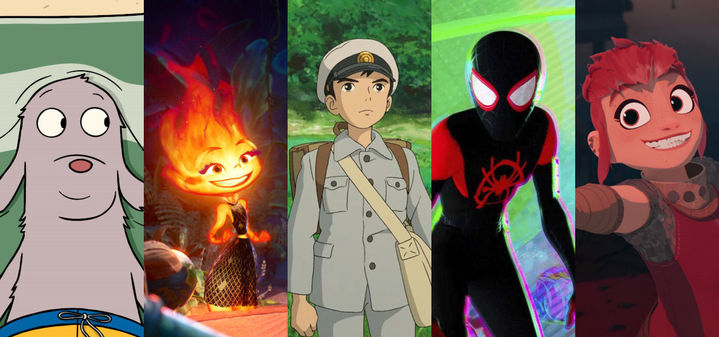
The five Oscar nominees for best feature films of 2024 ("Robot Dreams", "Elemental", "The Boy and the Heron", "Spider-Man: Across the Spider-Verse", and "Nimona") had a panel where certain directors of each film spoke about parts of the film's production; except for "The Boy and the Heron" which was represented by Dave Jesteadt, the President of GKIDS who distributed the film in the US, who spoke about his journey in distributing the film.
Peter Sohn ("Elemental") and Pablo Berger ("Robot Dreams") both talked about how their stories are not adaptations of existing stories and speak about the worries that comes with creating an original story and trying to understand what elements would work and connected to audiences. Tory Quane ("Nimona") also spoke about the insecurities of being vulnerable in a film, especially with LGBTQIA+ story and the production turmoils of developing the film. I felt connected to this since I have concerns about storytelling and how to efficiently and effectively communicate to my audience. So if Oscar nominated directors feel this way, it feels comforting to know that is a natural storytelling experience.
Peter Sohn ("Elemental") spoke about how objectivity gets lost by watching sequences and shots of a film for so long and the repetitiveness of a 90 minute feature since there is so much to pay attention to repetitively. This spoke to me since I lose objectivity in my sequences and end up thinking it's "good enough" for release, but help from my peers and industry artists helps me see my art in a new way. Joaquim Dos Santos ("Spider-Verse: Across the Spider-Verse") spoke about the Indian team at Sony engaged with the directors of changing Pavitr's character to reflect Indian characters, in seeing a character in a way that connects to audience better. As an Indian artist, this is really important to me that voices of minority groups are heard and reflected in the story.
Troy Quane ("Nimona") spoke about his perspective on inclusivity and the boundaries artists push artistically and narratively for their films in terms of style and filmic language. "I remember seeing the first Spider-Verse and a lot of comments were speaking about how it was a great film, but they would have liked to see it when it was 'finished'." I think this is based on the Disney-style animation dominating the perspective audiences had on animation and animated films when stylised animation would start penetrating the filmic market and cultural zeitgeist.

Bridget Dash & Anthony Kemp, DNEG Animation [27/02/24]


I was part of an audience that had an Industry talk from two DNEG employees Bridget Dash, a Recruiter, and Anthony Kemp, a Producer. Anthony Kemp gave a presentation on the creation and design of DNEG's most recent Oscar-nominated film, Nimona, which was presented at SIGGRAPH in the US. I took some notes that I found of interest.
-
The film from start of production to final delivery took 20 months, which was a very tight turnaround for any film.
-
They utilised motion graphics in their designs to make the city feel bustling and live for stores, ads, and banners to contrast the medieval and modern looks. Brand imagery in a film this large was important in order to communicate the futuristic-medieval .
-
The brands were inspired and drawn from Charly Harper design, who is an American artist with minimalist realism.
-
The film had 'levels of styles' where designs would be more detailed closer, but simplified when further away. Similar to DNEG's Entergalactic creating depth of detail, where the further the asset is from the screen the less detailed it becomes.
-
Used Parallaxed 3d designs so 2D images felt more 3D rather than a flat image.
-
In the film, the character Goldenloin has a moment of internal dialogue in a car where we see his internal thoughts on the n arrative. In the background, the number of cars increase and become more aggressive, which is a really effective use of environments to communicate the emotions of the characters.
-
DNEG created and developed "Ribbonized FX" where everything is made of ribbons.
-
From Nimona going from shadow monster to Nimona, fire, chimney smoke, Nimona's transformations, etc. Each ribbon is a curve with meshed shapes with a variation of mesh put on the simulation. They did this in order to achieve the stylised FX with Houdini.
-
They used Ribbon FX to guide the audience's eye. e.g. When Nimona turns from the dragon to younger her in front of the child.
-
After Anthony, Bridget Dash gave a presentation on DNEG as a company, and what they look for from artists in their pipeline.
-
DNEG as a company works as a production company, hired by client companies. They don't have an inhouse style, but each film is new. Pre-production isn't done in-house but rather by client companies and DNEG takes that pre-production and takes over the production to post-production which they then deliver to the client.
-
The company has a variety of extra curricular activities which anyone employed by DNEG can take. These are refered to as 'Series'
-
Inspire series: conversation with industry professionals like Guillermo del toro & Bill Kinder
-
Inquire Series: Conversation with Experts on a topic of topics
-
They also have a great industry presence, such as Annecy Film Festival, SIGGRAPH, OIAF, and FMX to participate in Panels and masterclasses. I am planning to visit Annecy film festival this June, so it may be a good opportunity to make industry connections.
-
-
Bridget provided a lot of information on DNEG, such as:
-
a demonstration of DNEG's pipeline which I added to my Research into DNEG as a company.
-
showreel tips on how to be appealing to recruiters.
-
"You are only as strong as your weakest piece."
-
"In your showreel title card, put logos of software you used, name, department, and email"
-
Put the reference in the small corner of the showreel so the employer can see how you interpret your work.
-
-
examples of a resume with mistakes and things to avoid in a CV from the perspective of a recruiter. "Hobbies are fine, but its rather better to put it in a cover letter."
-
interview tips. "Don't undersell yourself. Talk about your production and how long it took. The recruiter has seen what you can do technically, but the interview is a formal and professional way for the company to get to know you as an individual."
-


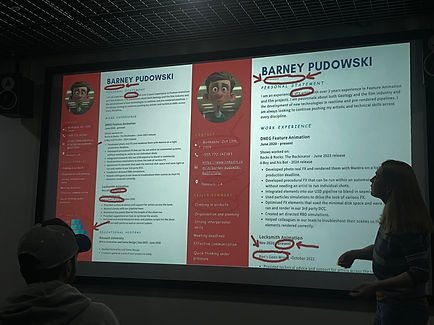

After the presentation, I also spoke with Bridget Dash and what she as a recruiter would like to see from an animation showreel for DNEG. (Which I took and applied to my Research on DNEG as a company)
-
Love to see two dialogue pieces, see a weightlifting with character work like sadness or happy that ha emotion, a body mechanic piece.
-
Do a piece with character that isn’t moving a lot, have movement but impactful. Shouldn’t have zaniness. Just focus on the character.
-
You can put work in progress but put “work in progress” at the bottom of the clip
Framestore - Studio Visit [25/09/23]
My peers and I had the opportunity to visit Framestore, a CG company in advertising, film, television and many other sectors for CG and aniamtion. I did sign an NDA for this studio visit, so while I will be presenting information I recieved, I will be mostly be recounting my experience at Framestore.
The company has a ton of departments that focus on a different sector for CG animation, which made me aware of the variety of different animation sectors which can exist within and outside of the conventional film & television industry
-
Framestore Pre-Production Services (Previs, Pitch-vis, Tech-vis branch)
-
Lot of Generalist animators and shot-animators using applications such as UnReal, Maya, etc.
-
-
Framestore Advertising
-
Features a small group of artists who are not as specialised as artists for film/TV roles, but not quite generalist roles.
-
Has turnaround times can range between very quick or quite long.
-
-
Framestore Pictures
-
External in-house directors who work with scripts and previs
-
-
Framestore Immersive
-
Section for anything that isn’t a conventional .mp4 file, like theme Parks, VR, AR, touring exhibition
-
No project is the same, since it has to fit the environment and not a conventional screen
Company Culture
-
Emphasis on people/socialising. Hosted events for ACCESS: VFX
-
It is flexible hybrid work
-
Framestore has a variety of societies
Training
-
Framestore offers in-house training to: build people’s interests, learning how to receive and give feedback, & help introversion or extroversion in not knowing how to approach this
-
Framestore mentee training program
-
In-house staff can be mentor/mentees
-
-
Internship Launchpad
-
During summer, applications open in January
-
You choose either a specialism or apply as a generalist
-
Creates a network of juniors
-
Open to Year 2, Year 3, or one year past education.
-
Portfolio/Showreel Tips
-
"Company reels are made by hundreds of people. Yours is made by one. Go easier on yourself, and don’t compare your reel to a company’s."
-
Put reference in top right corner like a small box in order for the recruiters to see how you interpret footage.
-
Put what you want to do. Projects will come and go, but do what you enjoy.
Education Improvements (Things that education facilities could improve to help industry hiring.)
-
More teamwork. No project is solo and collaboration is key.
-
Keep an eye on the industry. What tech developments are made? What software are you using?
-
Don’t be afraid to message people. Some people will reply, some people won’t; but you'll never know unless you've tried
-
It’s okay to change your mind in what you want to do.
-
A receptionist at framestore went to marketing, then production, and now is a Character Effects (CFX artist)
-
-
Talk about your workflow.
-
Principles, how it works, software, etc.
-
Talk through getting through A to B?
-
Answer the question: “What would you do if you had more time?”
-
Industry Talk - From Pencils to Pixels by Louis Peralta (31/10)
Translating Peter Cooke’s Drawings into Immersive Digital Environments


I had the opportunity to attend a talk from Industry Guest Louis Peralta, an Architectural Assistant at CHAP, who translated Peter Cooke's 2D watercolour paintings into 3D architectural assets for exhibition.
For this project, Peralta used Blender in his workflow based on his experience with the software and its capabilities for modelling and texturing. Even if it was for a role and sector I am not aiming for, it was engaging to hear and see a Blender workflow for a project in a sector outside of the typical animation industry. Due to my Blender explorations (see "Development Work") this was really engaging to see another artist using Blender, especially in understanding how an artist develops their work and finding creative solutions to achieve client's vision within a short turnaround.
Since the project was more focused on architecturally exhibiting the work, it was really fascinating to see the visual priorities in another industry sector: with the modelling focus, the animation used was simply to demonstrate audience scale to the exhibition pieces and the intended flow of traffic through the space.